The Healthy Diet Basket is a valid global standard that highlights lack of access to healthy and sustainable diets
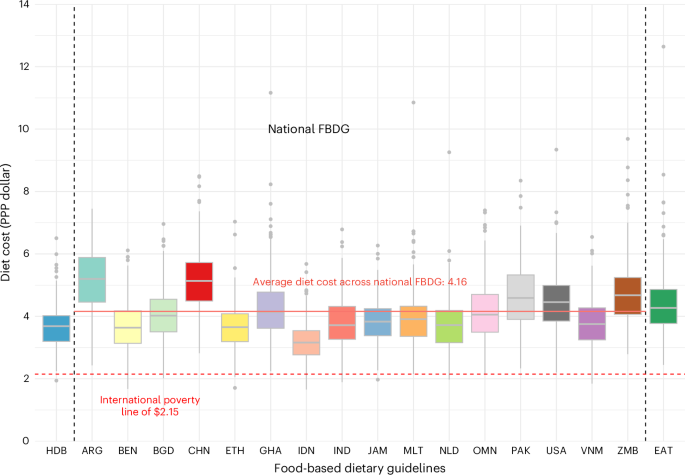
In this study, we calculated the cost and nutritional and environmental outcomes of a healthy diet by following a structured methodology using multiple dietary guidelines and national food price data. We began by identifying the specific requirements of various FBDG included in the analysis, including the HDB, national FBDG and the EAT-Lancet reference diet. Food price data were sourced from the ICP, a unique dataset that provides nationally representative average prices for a comprehensive range of food items across 173 countries in the most recent 2021 cycle. Each food item was matched with food composition tables to obtain calorie content and edible portion information, enabling conversion from price per kilogram to price per calorie. We used rank-order optimization to identify the lowest-cost items that meet the requirements of FBDG and calculated total diet costs in local currency, subsequently converting them to 2021 PPP dollars. Finally, we calculated both the nutritional and environmental outcomes for these least-cost healthy diets based on the quantities and prices of the selected foods. Statistical analyses were conducted using Stata MP18 and RStudio 2023.12.0 to assess variations in diet costs and affordability, nutritional indicators and environmental impacts.
The HDB standard
The HDB comprises average recommended amounts of the most commonly recommended food groups in national FBDG: starchy staples, vegetables, fruits, protein-rich foods (both animal source and plant source) and oils/fats. The HDB was developed in 2022, from 10 quantified FBDG (the most recent within each major region) and 30 semi-quantified food guides from all regions of the world9. For the quantified FBDG, the recommended amounts of each food group were identified and converted from grams or heterogeneous servings into energy equivalents55. The total dietary energy was standardized to 2,330 kcal for comparability, and each food group recommendation was adjusted proportionally (Supplementary Table 1). Beyond countries where fully quantified guidelines were examined, many other countries have semi-quantified guidance that is shown pictorially in food guides (for example, plates, pyramids). Thirty countries were identified with semi-quantifiable food guides, which show food group proportionality approximately by volume, similar to the way food appears on a plate. The average recommended amounts in quantified guidelines were compared to the proportions shown in semi-quantitative food guides (Supplementary Table 2).
The dietary energy needs of an active 30-year-old woman, 2,330 kcal, were used as a standard energy requirement. This level of dietary energy is close to the median (2,328 kcal) and weighted mean (2,322 kcal) energy requirement of each sex, activity level and pregnancy and lactation status at each year of age (over 2 years)10. The dietary energy needs of a 30-year-old woman are therefore a reasonable representation of a generic total population. Previous research has demonstrated that least-cost diets to meet energy and nutrient requirements for people in this reference group are approximately the median level of costs for all sex–age groups over the entire life cycle44.
The average recommended proportions for each food group, standardized into caloric equivalents, form the HDB (Table 1). In terms of dietary energy, these are approximately one-half from starchy staples, one-quarter from protein-rich foods, one-eighth from vegetables and fruits, and one-eighth from oils and fats. By volume (appearance on a plate), these proportions correspond to approximately one-quarter starchy staples, one-quarter protein-rich foods, one-half fruits and vegetables, and a small proportion of added oils and fats (Extended Data Fig. 1 and Supplementary Table 3). These proportions reflect the modal volumetric proportions across all the plate-shaped food guides of countries around the world (Supplementary Table 2).
FBDG universally emphasize the need for variety within and between food groups56. For its function as a cost standard, the HDB operationalizes the construct of variety by specifying the number of least-cost items in each food group as two fruits; three vegetables; two starchy staples; two animal-source foods; one legume, nut or seed; and one oil or fat: 11 items in total (Table 1). The total number aligns FBDG that include a recommendation on number of foods to consume in 1 day; for example, China’s FBDG aim for 12 different individual foods or more in a day.
FBDG quantification
In this study, we use FBDG from Argentina, Bangladesh, Benin, China, Ethiopia, Ghana, Indonesia, India, Jamaica, Malta, Netherlands, Oman, Pakistan, the United States, Viet Nam and Zambia12,13,14,15,16,17,18,19,20,21,22,23,24,25,26,27. They were accessed primarily through the FAO FBDG repository, and all materials were available in English, Spanish and/or French57. As a reference for a diet pattern with low environmental impact, the EAT-Lancet reference diet was also quantified for comparison with the HDB, using the mean reference amounts of each food group11. The detailed quantification of each FBDG is publicly available55.
Diet cost analysis
The CoHD is computed by classifying food items into specified food groups, calculating the cost per day of each retail item in quantities required to meet energy targets and using rank-order optimization to select lowest-cost items in each food group. The cost per day of a retail food item, i, is based on its price per kilocalorie, pi, multiplied by the quantity, qi, required to meet the relevant energy target within a food group. Food group costs are then calculated by summing the cost per day of lowest-cost items selected into each food group, as follows, using the HDB food groups and energy targets:
$$\begin{array}{l}{\rm{Cost}}_{\rm{StarchyStaples}}=\min\left\{\mathop{\sum}\limits_{i=1}^{2}{p}_{i}{q}_{i}\right\},\,{\rm{where}}\,{\rm{each}}\,{q}_{i}\\\qquad\qquad\qquad\quad=580\,{\rm{kcal}}\,{\left(=\frac{1,\!160}{2}\right)}\;{\rm{and}}\,{\rm{item}}\,i\,{\rm{is}}\,{\rm{a}}\,{\rm{starchy}}\,{\rm{staple}}\,\end{array}$$
(1)
$$\begin{array}{l}{\rm{Cost}}_{\rm{AnimalFoods}}=\min\left\{\mathop{\sum}\limits_{i=1}^{2}{p}_{i}{q}_{i}\right\},{\rm{where}}\,{\rm{each}}\,{q}_{i}=150\,{\rm{kcal}}\,\left(=\frac{300}{2}\right)\\\quad\;{\rm{and}}\,{\rm{item}}\,i\,{\rm{is}}\,{\rm{an}}\,{\rm{animal}}\,{\rm{source}}\,{\rm{food}}\,\end{array}$$
(2)
$$\begin{array}{l}{\rm{Cost}}_{\rm{LegsNutsSeeds}}=\left\{\,{p}_{i}{q}_{i}\right\}\,,{\rm{where}}\,{\rm{each}}\,{q}_{i}\\\qquad\qquad\qquad\quad=300\,{\rm{kcal}}\,{\rm{and}}\,{\rm{item}}\,i\,{\rm{is}}\,{\rm{a}}\,{\rm{legume}},\,{\rm{nut}}\,{\rm{or}}\,{\rm{seed}}\,\end{array}$$
(3)
$$\begin{array}{l}{\rm{Cost}}_{\rm{Vegetables}}=\min\left\{\mathop{\sum}\limits_{i=1}^{3}{p}_{i}{q}_{i}\right\},{\rm{where}}\,{\rm{each}}\,{q}_{i}\\\qquad\qquad\quad\;\;\,=66.7\,{\rm{kcal}}\,\left(=\frac{110}{3}\right)\;{\rm{and}}\,{\rm{item}}\,i\,{\rm{is}}\,{\rm{a}}\,{\rm{vegetable}}\,\end{array}$$
(4)
$$\begin{array}{l}{\rm{Cost}}_{\rm{Fruits}}=\min\left\{\mathop{\sum}\limits_{i=1}^{2}{p}_{i}{q}_{i}\right\},{\rm{where}}\,{\rm{each}}\,{q}_{i}\\\qquad\qquad\;=80\,{\rm{kcal}}\,\left(=\frac{160}{2}\right)\;{\rm{and}}\,{\rm{item}}\,i\,{\rm{is}}\,{\rm{a}}\,{\rm{fruit}}\,\end{array}$$
(5)
$${\rm{Cost}}_{\rm{OilsFats}}=\{\,{p}_{i}{q}_{i}\}\,,\,{\rm{where}}\,{\rm{each}}\,{q}_{i}=300\,{\rm{kcal}}\,{\rm{and}}\,{\rm{item}}\,i\,{\rm{is}}\,{\rm{a}}\,{\rm{fat}}\,$$
(6)
The total CoHD is calculated by summing costs across food groups, as follows:
$${\rm{Cost}}_{\rm{HealthyDiet}}=\mathop{\sum}\limits_{j=1}^{6}{\rm{Cost}}_{j},\,{\rm{for}}\,{\rm{all}}\,j=\{1,\,\ldots ,\,6\}\,{\rm{food}}\,{\rm{groups}}$$
(7)
The food groups and energy targets in the above set of equations are adjusted for each national FBDG when computing the lowest cost of meeting each FBDG, and the EAT-Lancet reference diet55.
To compare diet costs across countries, we used retail price data reported by national statistical agencies through the ICP, managed by the World Bank as part of a global statistical collaboration under the United Nations Statistical Commission58. The ICP collects prices for standardized items worldwide to compute PPP. For this study, we used 2021 ICP prices, the latest available round. These data provide annual average, seasonally adjusted and nationally representative prices in local currency units for 735 foods and non-alcoholic beverages across 173 countries.
For the diet cost analysis following the HDB, 562 items were used. Excluded items included those that were non-caloric, ingredients, condiments, baby food, items with unclear composition and foods not recommended as part of a healthy diet, such as trans fats, sugar-sweetened beverages and processed meats. The dataset provides extensive food item coverage across countries, with an average of 105 priced food items per country. Detailed information on item numbers used for the calculation of CoHD in each HDB food group can be found in Supplementary Table 4.
The variation in the number of countries included in the analysis for each dietary guideline is due to the availability of price data. FBDG may require specific food groups, and in some countries, price data for items within those groups may not be available. This results in slight differences in the number of countries analysed across the various diets. Data were then available from 172 countries to calculate the cost of meeting the FBDG of Argentina, Benin, Malta, Pakistan, the United States and Viet Nam; 171 countries for the HDB, FBDG of Bangladesh, China, Ghana, India, Indonesia, Jamaica, the Netherlands and Zambia; 169 countries for FBDG of Ethiopia and Oman; and 162 countries for EAT-Lancet as it requires the most specific food groups.
The diet cost estimation in local currency units were then converted to 2021 PPP dollars using the latest PPP conversion factors for households and non-profit institutions serving households final consumption expenditure (previously termed private consumption). This approach differs slightly from the State of Food Security and Nutrition in the World 2024 report, which estimates the CoHD based on 2017 PPP prices7.
We then compared the CoHD following the HDB with GNI per capita per day and food expenditures per capita per day, by country, sourced from national accounts data on household food expenditures assembled by the World Bank59.
Analysis of nutrient content and other nutritional characteristics
The macro- and micronutrient content of the least-cost diets meeting criteria for the HDB, 16 national FBDG and the EAT-Lancet reference diet were analysed for up to 172 countries. For macronutrients, we examined whether the proportions of carbohydrate, fat and protein fall within the AMDR60. For 15 micronutrients and protein, we apply global harmonized average requirements, which are the levels of nutrients that meet the needs of 50% of the healthy population of each age and sex61. Beyond nutrients, we assessed the extent to which the diets met global healthy diet recommendations related to protection of health against noncommunicable diseases. These include recommendations on dietary components to include in healthy diets (at least 400 g fruits and vegetables and at least 25 g fibre daily, and consumption of whole grains, legumes, nuts and seeds) and to limit in healthy diets (excessive sugar (<10% dietary energy), salt (<5 g d−1), total fat (≤30% dietary energy), saturated fat (<10% dietary energy), little if any processed meat and red meat (no more than 350–500 g week−1, or 71 g d−1))28,29. They are summarized as a simple count of the number of WHO dietary recommendations met. The performance of the HDB and other FBDG in other diet quality scoring systems, the Alternative Healthy Eating Index and Diet Quality Index-International was also assessed in auxiliary analyses62,63.
Analysis of environmental impact
To examine environmental impact, we calculated the GHGe (in kg CO2eq per person per day) and water use (litres per person per day) of the least-cost diets that met the HDB, FBDG and EAT-Lancet criteria. Food items in the ICP food price list were matched to food items in a database of carbon and water footprints64. Items without an exact match were matched to the closest item within the same food group, in terms of biological similarity (for example, same species, genus or family) and edible portion. Then the GHGe and water use of each least-cost diet were calculated for up to 172 countries.
Statistics and reproducibility
This study uses nationally representative food price datasets across 173 countries. No statistical method was used to predetermine sample size. Countries were omitted only when necessary due to missing food price or other required data. As this study is based on secondary data analysis of national datasets, randomization and blinding were not applicable. Investigators were not blinded to data allocation during analysis and outcome assessment. The methodology follows standardized approaches for diet cost estimation and nutritional and environmental assessment, ensuring consistency and reproducibility.
Reporting summary
Further information on research design is available in the Nature Portfolio Reporting Summary linked to this article.
link