Beauty, Wellness, and the Medical Aesthetics Boom
Pt. III: Glowing Up
Platforms and clinics are combining diagnostics, dermatology, and body sculpting to establish concierge looksmaxxing as a consumer service.
Looks labs
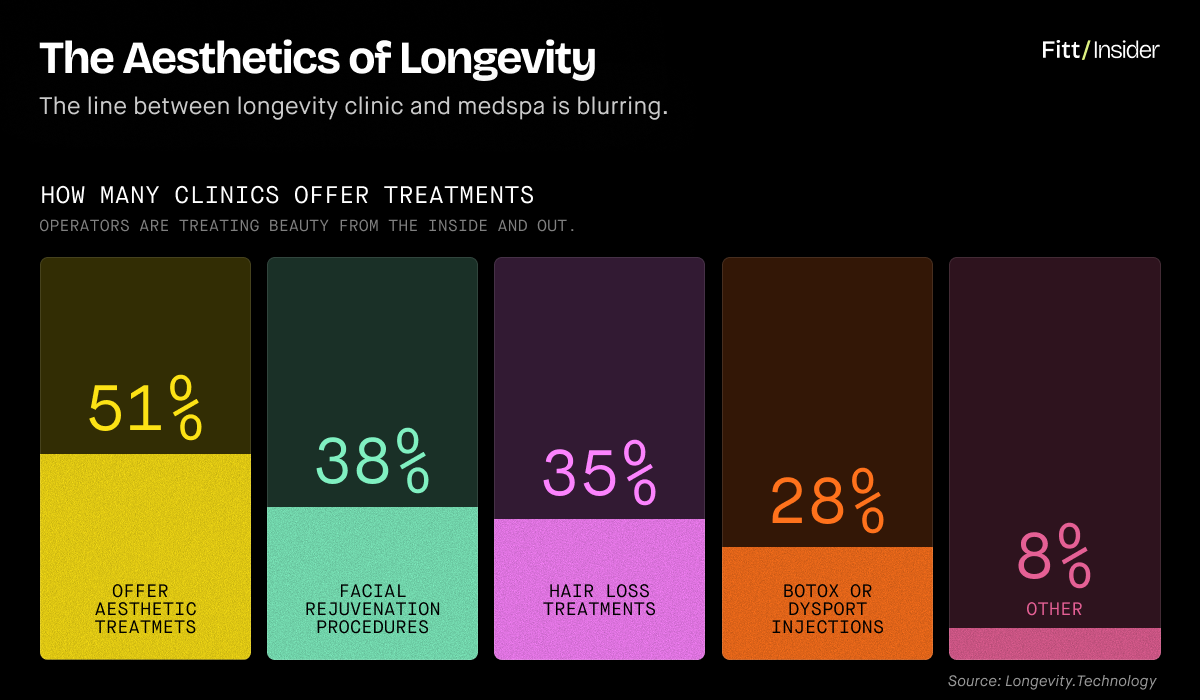
As noninvasive aesthetic procedures advance, the line between medspa and longevity clinic is blurring. Early proof, an April survey of 82 longevity clinics revealed 28% offer Botox, 35% tackle hair loss, and 38% perform “facial rejuvenation” procedures.
The move toward longevity marketing extends appeal beyond those chasing vanity, capturing people who preach personal health responsibility. Buying the rebrand, the number of men receiving minimally invasive cosmetic procedures spiked 29% from 2000–2020.
Reduced stigma means 73% of consumers are now open to cosmetic treatments, with injectables, microneedling, laser resurfacing, and chemical peels sparking the most curiosity. Predicting patients will want to look better once they feel better, clinics like Fountain Life and Next Health offer aesthetic care add-ons.
From Skin Laundry’s signature laser facials to Great Many’s plasma-powered hero service for hair loss, tech is transforming beauty treatments. At Four Seasons Maui, options include cryofacials and i-lipo, a laser-based alternative to traditional liposuction. Recreating Seoul in SF, Saelo’s Korean-inspired clinic nanoneedles exosomes.
Nesting beauty within holistic retreats, SHA precedes services with diagnostics and facial scans for personalized skin, hair, and smile fixes. Data-driven, Aesthetica Skin Lab’s membership program includes advanced skin age analysis, custom facials, and 1:1 dermatologist consults.
Looking ahead, 25% of GLP-1 users are interested in post-weight-loss procedures, meaning nonsurgical lifting treatments like Emsculpt Neo, Ultherapy, and Sofwave—which employ radiofrequency and ultrasound—could see spikes.
Tox talk
As #no-tox spreads, clinics are wrapping the old neurotoxin in new narratives.
Insisting injections empower, Merz Aesthetics counts Joe Jonas, Demi Lovato, and Gwyneth Paltrow as ambassadors for its Botox competitor, Xeomin. Being mindful, Skin Pharm preaches subtlety, Peachy uses AI to avoid overtreating, and Self London offers psych evals on site.
While Botox is widely accepted as safe, research shows it alters amygdala activity, affecting emotional processing. With pushback brewing and “Mar-a-Lago face” making news, cosmetic acupuncture is rising as a natural alternative, sending Google searches up 248% in two years.
Boasting whole-body benefits, an acu-approach stimulates rather than paralyzes muscles — strengthening mind-body connection instead of numbing it. Beyond smoothing wrinkles, studies show it reduces asymmetries and adds contour while boosting blood flow and moisture.
AI-estheticians
Full-stack and tech-forward, brands are designing digital journeys to guide purchase decisions.
Democratizing dermatology, GetHarley’s online office advises on everything from hormonal acne to healthy aging. An employee benefit program, JOYA emphasizes skin cancer prevention. Targeting psoriasis and eczema, Zest Health caters care to the modern workforce.
Personalizing subscriptions, Curology provides access to prescription-strength products. Even more precise, Parallel onboards customers with at-home tests for microbiome-specific serums, while Happy Head follows a similar process for scalp struggles. Keeping transformations in house, Hims and Ro stack skin and hair loss solutions alongside weight loss drugs.
If the Personal Health OS becomes reality, platforms could one day sync data from wearables and invisible diagnostics to inform custom AI-driven care plans — incorporating metrics like metabolic health, hormones, hydration, and microbiome to adjust skincare regimens as needed.
Key insight: There’s a new stack emerging at the edge of wellness, aesthetics, and aging. Diagnostics like biological age, hormone panels, and DEXA scans are meeting treatments like injectables, lasers, and sculpting — with home devices, peptides, and supps rounding out routines.
link